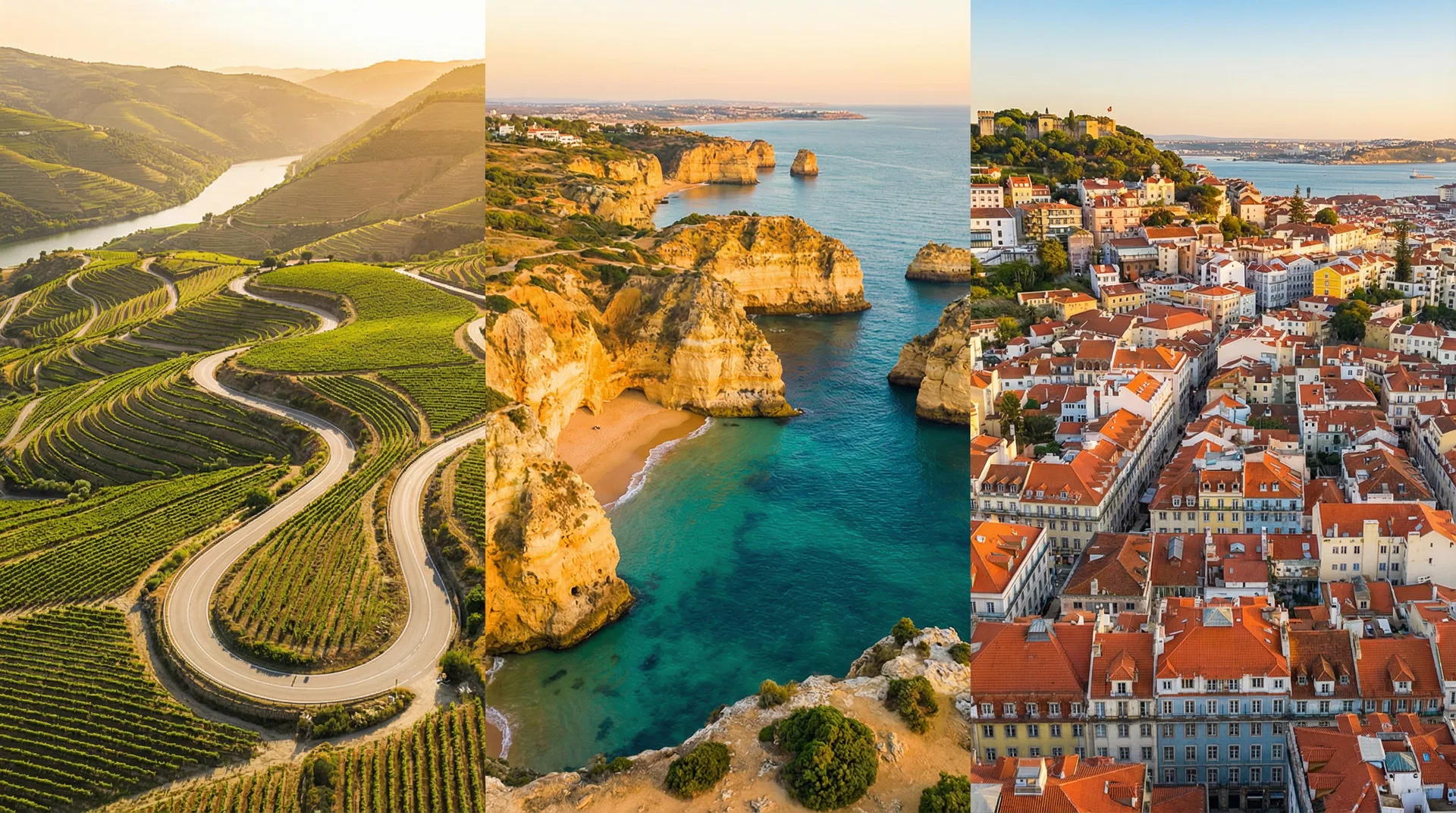
Best Road Trips in Portugal
Discover the most scenic road trips across Portugal — from the Algarve coast to the Douro Valley and beyond.
Best Road Trips in Portugal: Your Ultimate Guide to Exploring Portugal by Car
Seven road trips. One country. Portugal fits into a space smaller than the UK, yet it contains Atlantic surf beaches, Saharan-dry plains, terraced wine valleys, volcanic islands, and medieval walled cities — all within a few hours of each other. This guide to the best road trips in Portugal gives you seven tested itineraries with distances, driving times, and the stops that most travel guides miss, so you can plan a route that matches your pace and interests.
Before you set off, compare rental car prices across all Portuguese airports and cities through GooRentalCars — booking in advance, especially in summer, can save you 30–50% compared to walk-up rates.
Road Trip 1: The Algarve Coast — Faro to Sagres (200 km, 3–5 days)
This is Portugal's most iconic road trip, and it earns that reputation. Starting at Faro Airport, you drive west along the EN125 — the old coastal road that predates the motorway and passes through every fishing village and clifftop town the Algarve has to offer. The first major stop is Albufeira, where the old town sits above a beach that was once a quiet fishing cove and is now one of the most visited in Europe. Continue west to Portimão and the Praia da Rocha, then to Lagos, where the Ponta da Piedade sea caves are the most photographed coastline in Portugal.
From Lagos, the road narrows and the landscape becomes wilder. The EN125 continues to Sagres, the southwestern tip of continental Europe, where Henry the Navigator established his school of navigation in the 15th century and where the Atlantic wind is strong enough to lean into. The Fortaleza de Sagres sits on a 60-metre cliff above the ocean. Drive north from Sagres to Cabo de São Vicente — the actual westernmost point of continental Europe — for a sunset that is genuinely difficult to describe.
Key stops: Faro, Albufeira, Portimão, Lagos, Sagres, Cabo de São Vicente
Best season: May–June or September–October (avoid August crowds)
Road Trip 2: The Douro Valley Wine Route — Porto to Pinhão (120 km, 2–3 days)
The Douro Valley road trip begins in Porto and follows the river east into the schist hills where port wine has been produced for three centuries. Take the A4 motorway east to Amarante, then drop south to Peso da Régua on the N101 — the point where the valley opens up and the terraced vineyards begin. From Régua, the N222 follows the river to Pinhão, and this 25-km stretch is consistently rated among the most scenic roads in Europe. The road hugs the riverbank, passing quintas (wine estates) with their distinctive blue-and-white azulejo tile panels, and the views across the valley change with every bend.
In Pinhão, stay overnight and book a cellar tour at one of the quintas — Quinta do Crasto, Quinta do Vale Meão, or Quinta Nova all offer tastings with panoramic views. On the second day, drive north from Pinhão on the N323 to the Miradouro de São Leonardo de Galafura, where the view across the valley is extraordinary in the late afternoon light. Return to Porto via the A4, or continue east to the Spanish border for a two-country road trip.
Key stops: Porto, Amarante, Peso da Régua, Pinhão, Quinta do Crasto
Best season: September–October (harvest season, vineyards at their most dramatic)
Road Trip 3: The Silver Coast — Lisbon to Porto via the Coast (350 km, 3–4 days)
Most travellers drive between Lisbon and Porto on the A1 motorway in three hours. The Silver Coast route takes three days and is infinitely more rewarding. From Lisbon, drive north on the A8 to Óbidos — the perfectly preserved medieval walled town that makes the perfect first night stop. Continue north to Nazaré, where the beach is one of the longest in Portugal and the waves in winter are the biggest in the world (Praia do Norte regularly hosts 20-metre surf). From Nazaré, the N242 winds inland to Alcobaça, where the Mosteiro de Alcobaça is one of the finest examples of Gothic architecture in Europe.
Continue north to Figueira da Foz, then to Aveiro — the "Venice of Portugal" — where moliceiro boats painted in bright colours navigate the ria (lagoon). From Aveiro, the A1 takes you to Porto in 45 minutes, or you can take the coastal road through Espinho for a final stretch of Atlantic views.
Key stops: Óbidos, Nazaré, Alcobaça, Figueira da Foz, Aveiro, Porto
Best season: April–June (wildflowers on the clifftops, uncrowded beaches)
Road Trip 4: The Alentejo Plains — Évora to the Spanish Border (250 km, 2–3 days)
The Alentejo is the least-visited region of mainland Portugal and, for many travellers, the most memorable. The landscape is vast and unhurried — cork oak forests, wheat fields, olive groves, and whitewashed villages that look exactly as they did 200 years ago. Start in Évora, the Roman capital of the region, and spend a morning at the Roman Temple and the Chapel of Bones before driving south on the N380 to the Alqueva reservoir — the largest artificial lake in Western Europe, surrounded by dark sky reserves that make it one of the best stargazing destinations in Europe.
From Alqueva, drive east to Monsaraz, the hilltop walled village that overlooks the reservoir, then north to Marvão — a fortress town perched on a granite ridge at 865 metres with views into Spain. The drive from Monsaraz to Marvão on the N246 passes through the Serra de São Mamede Natural Park, where the landscape shifts from plains to forested hills and the road climbs through hairpin bends to the village gates.
Key stops: Évora, Alqueva, Monsaraz, Castelo de Vide, Marvão
Best season: March–May (wildflowers, mild temperatures, empty roads)
Road Trip 5: The Minho Green Route — Porto to Valença (150 km, 2–3 days)
The Minho is the greenest corner of Portugal, watered by Atlantic rain and crossed by rivers that flow into the sea at the Spanish border. From Porto, drive north on the A3 to Braga — Portugal's religious capital, with the Bom Jesus do Monte sanctuary rising above the city on a Baroque staircase of 577 steps. Continue north to Guimarães, the birthplace of Portugal, where the medieval castle and palace of the Dukes of Bragança are UNESCO World Heritage Sites.
From Guimarães, take the N101 west to Viana do Castelo, where the Basílica de Santa Luzia sits on a hilltop above the Lima estuary and the view from the terrace takes in the entire coast. Drive north along the N13 coastal road to Caminha and Valença, the fortified border town that faces the Spanish city of Tui across the Minho river. The bridge between the two countries is one of the most dramatic border crossings in Europe.
Key stops: Braga, Guimarães, Ponte de Lima, Viana do Castelo, Valença
Best season: May–June (hydrangeas in bloom, mild temperatures)
Road Trip 6: The Beiras — Coimbra to the Serra da Estrela (200 km, 2–3 days)
The Beiras region, between Lisbon and Porto, is often overlooked in favour of the coast and the Algarve. This is a mistake. Coimbra, the university city on the Mondego river, has one of the most beautiful university libraries in the world — the Biblioteca Joanina, with its gilded baroque shelves and resident colony of bats that eat the insects that would otherwise damage the books. From Coimbra, drive east on the N17 to the Serra da Estrela — the highest mountain range in mainland Portugal, where the Torre peak reaches 1,993 metres and the landscape in winter is covered in snow.
The village of Manteigas, in the glacial valley below the Torre, is the base for hiking the glacial valley of Zêzere and the levada walks that wind through the mountains. Drive the N339 from Manteigas to Seia for a mountain road that rivals anything in the Alps for drama, then continue south to Castelo Branco and the Monsanto boulder village for the final leg of the journey.
Key stops: Coimbra, Serra da Estrela, Manteigas, Monsanto, Castelo Branco
Best season: July–August (Serra da Estrela accessible, wildflowers in bloom)
Road Trip 7: The Setúbal Peninsula — Lisbon to Comporta (120 km, 2 days)
This is the road trip that Lisbon locals keep to themselves. The Setúbal Peninsula, south of Lisbon across the Tagus, contains the Arrábida Natural Park — a stretch of limestone cliffs and turquoise water that looks more like the Mediterranean than the Atlantic. Drive south from Lisbon on the A2, cross the Tagus on the Ponte 25 de Abril, and take the N10 to Setúbal. From Setúbal, the N379 winds through the Arrábida hills to Portinho da Arrábida, where the water is so clear and blue that it is difficult to believe you are still in Portugal.
Continue south to Comporta, the low-key beach destination where Lisbon's creative class retreats in summer — rice fields, pine forests, and long empty beaches with no high-rise hotels. The drive back to Lisbon on the A2 takes 90 minutes, but the memories of the Arrábida cliffs and the Comporta dunes last considerably longer.
Key stops: Setúbal, Portinho da Arrábida, Sesimbra, Comporta
Best season: June–September (warm water, long evenings)
Related Articles
- Best Places to Visit in Portugal by Car
- Rent a Car in Portugal: The Complete Guide
- Driving in Portugal: Tips and Rules
Frequently Asked Questions (FAQ)
Q: How long do I need for a Portugal road trip?
A: A minimum of 7 days allows you to cover one or two regions properly. Two weeks is ideal for combining the north (Porto, Douro Valley, Minho), the centre (Coimbra, Óbidos, Sintra), and the south (Alentejo, Algarve). If you only have a long weekend, the Douro Valley from Porto or the Arrábida from Lisbon are both excellent two-day options.
Q: Is it safe to drive in Portugal?
A: Portugal is generally safe for driving. The motorway network is modern and well-maintained. Rural roads can be narrow, particularly in the Alentejo and Minho, so reduce speed and be prepared for oncoming traffic. The main hazard in summer is fatigue on long straight roads in the Alentejo heat — take regular breaks and keep water in the car.
Q: Do I need to pay tolls on Portuguese roads?
A: Yes, most Portuguese motorways (A-roads) have tolls. Some are traditional barrier tolls where you pay cash or card; others are electronic (no barrier) and require a Via Verde transponder. Ask your rental company about transponder rental, or register your vehicle at a CTT post office within five days of using an electronic toll road.
Q: What is the speed limit in Portugal?
A: The speed limit is 50 km/h in urban areas, 90 km/h on national roads (N-roads), and 120 km/h on motorways (A-roads). Speed cameras are common, particularly on the A1 between Lisbon and Porto. The legal blood alcohol limit is 0.5 g/L (lower than the UK's 0.8 g/L).
Q: Can I take a rental car from Portugal to Spain?
A: Most rental companies allow cross-border travel to Spain with advance notice. Some charge a small cross-border fee. Check with your rental company before booking, and ensure your insurance covers Spain. The border crossings at Valença/Tui (north), Vilar Formoso/Fuentes de Oñoro (centre), and Vila Real de Santo António/Ayamonte (south) are all straightforward.
Q: What is the best rental car size for a Portugal road trip?
A: A compact car (VW Polo, Ford Fiesta, or similar) is ideal for most Portugal road trips — easy to park in historic town centres, economical on fuel, and perfectly adequate for motorway driving. If you are travelling with four adults and luggage, a mid-size car (VW Golf, Seat León) gives more comfort. For mountain roads in the Serra da Estrela or Minho, a car with good ground clearance is an advantage but not essential.