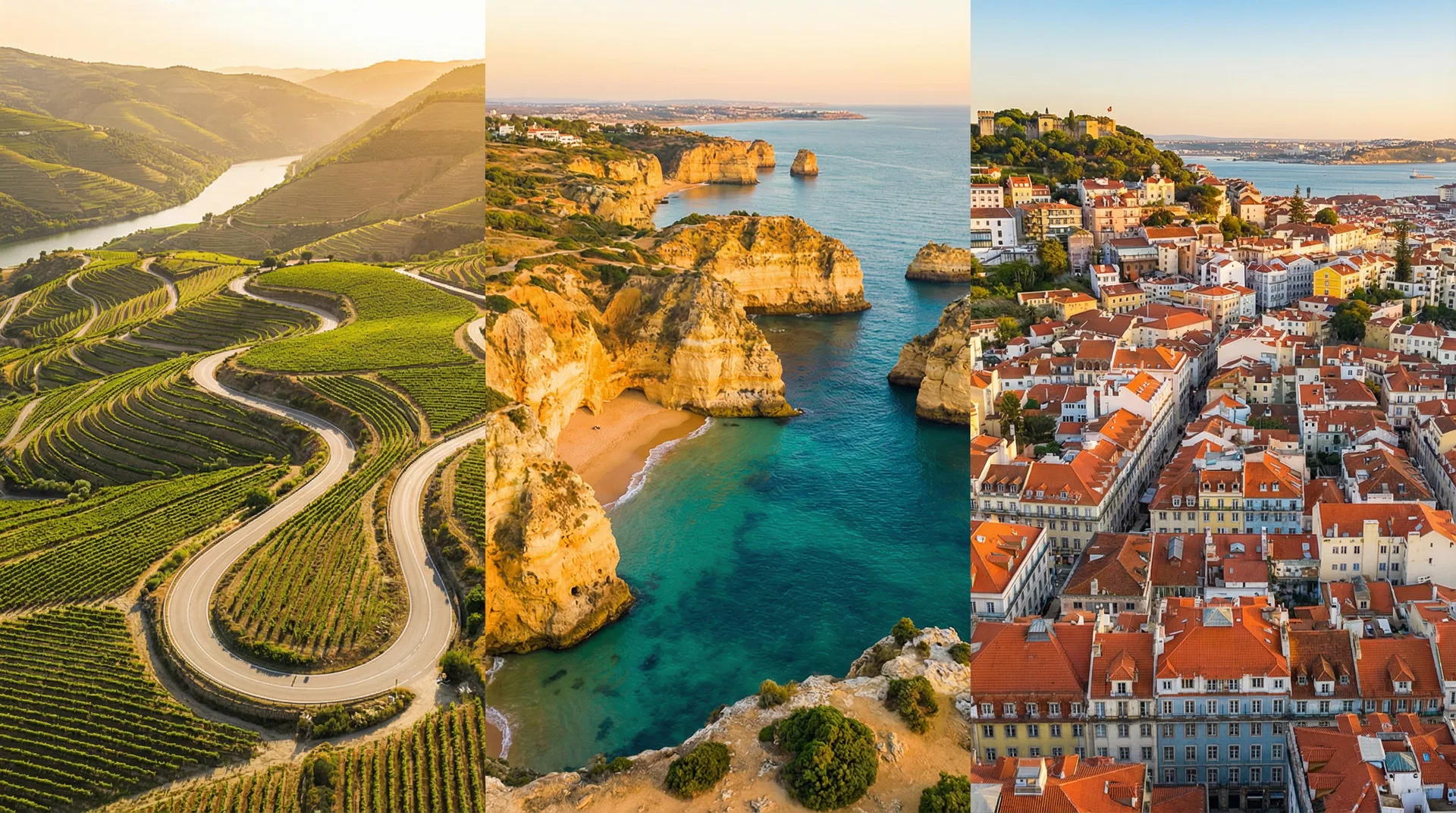
Best Places to Visit in Portugal by Car
The top destinations in Portugal that are best explored by car — from hidden villages to stunning coastal viewpoints.
Best Places to Visit in Portugal by Car: Your Ultimate Road Trip Guide
Portugal has 17 UNESCO World Heritage Sites, 1,794 km of coastline, and a wine region that stretches from the Douro Valley to the Alentejo plains. The challenge is not finding things to do — it is choosing which regions to prioritise and how to connect them efficiently. This guide to the best places to visit in Portugal by car organises the country into ten distinct destinations, each with its own character, so you can build an itinerary that goes beyond Lisbon and the Algarve.
Why a Rental Car Is the Best Way to See Portugal
Portugal's train and bus network connects the major cities well, but the places that genuinely take your breath away — the hilltop villages of Alentejo, the terraced vineyards of the Douro Valley, the sea caves of the Algarve — are simply not reachable without your own transport. A rental car gives you the freedom to stop at a roadside miradouro (viewpoint) when the light is perfect, to detour into a village that isn't in any guidebook, and to cover the distances between regions at your own pace.
Roads in Portugal are generally excellent. The motorway network (autoestradas) is modern and well-maintained, and even secondary roads in rural areas are usually in good condition. Tolls are common on the A-roads, so budget for Via Verde charges or ask your rental company about a transponder. For the best rental rates across all Portuguese locations, compare options through GooRentalCars before you travel.
The 10 Best Places to Visit in Portugal by Car
1. Sintra — Fairy-Tale Palaces Above the Atlantic
Sintra sits 30 km west of Lisbon in the Serra de Sintra hills, and it is unlike anywhere else in Europe. The Palácio Nacional da Pena, painted in vivid yellow and terracotta, rises above the forest like something from a fairy tale. The Quinta da Regaleira hides a 27-metre initiatic well and underground tunnels. The Palácio de Monserrate is a Moorish-Gothic fantasy surrounded by botanical gardens. Driving here from Lisbon takes 35 minutes on the A37, but the real pleasure is the road back — take the N247 coastal route through Cabo da Roca (the westernmost point of continental Europe) and down to Cascais.
2. The Douro Valley — Portugal's Wine Country
The Douro Valley, two hours east of Porto on the A4, is one of the most visually spectacular regions in Europe. The river cuts through schist hillsides terraced with port wine vineyards, and the light in late afternoon turns everything amber and gold. The town of Pinhão is the heart of the valley — small, quiet, and surrounded by quintas (wine estates) that offer tastings and cellar tours. Drive the N222 from Peso da Régua to Pinhão for what many consider the most scenic road in Portugal. Stop at the Miradouro de São Leonardo de Galafura for a panoramic view that stretches for 40 km.
3. Óbidos — A Medieval Town Inside Its Own Walls
Óbidos is a perfectly preserved medieval town enclosed within 13th-century walls, 80 km north of Lisbon on the A8. You can walk the entire circuit of the walls in 20 minutes, looking down over white-and-blue houses draped in bougainvillea. The town is famous for its ginjinha (cherry liqueur), traditionally served in a chocolate cup. Óbidos hosts a medieval market every July that transforms the town into a living history exhibit. It makes an ideal stop on the drive between Lisbon and Porto, breaking the journey with a two-hour detour that most travellers remember more vividly than either city.
4. Évora — Roman Ruins in the Alentejo Plains
Évora, 130 km east of Lisbon on the A6, is the capital of the Alentejo region and one of Portugal's most historically layered cities. The Roman Temple of Évora, dating from the 1st century AD, stands in the city centre in near-perfect condition. The Igreja dos Ossos (Chapel of Bones) is built from the skulls and femurs of 5,000 monks — confronting and unforgettable. The surrounding Alentejo plains produce some of Portugal's finest olive oil, wine, and black pork, and the drive out of Évora on the N380 towards the Alqueva reservoir passes through cork oak forests and whitewashed villages that feel entirely untouched by tourism.
5. The Algarve Coast — Sea Caves, Cliffs, and Hidden Beaches
The Algarve needs little introduction, but the difference between experiencing it by car and by organised tour is enormous. With a rental car, you can reach Praia da Marinha (consistently ranked among Europe's most beautiful beaches) before the crowds arrive at 10am. You can drive the EN125 from Faro to Sagres and stop at every miradouro along the way. You can reach the Ponta da Piedade sea caves by parking above Lagos and walking down the cliff path. The western Algarve around Sagres and Vila do Bispo is wilder and less developed — the kind of coastline that reminds you why people fell in love with Portugal before it became famous.
6. Monsanto — The Village Built Among Boulders
Monsanto, in the Beira Baixa region 280 km northeast of Lisbon, was voted "the most Portuguese village in Portugal" in 1938, and the title stuck. The village is built literally among enormous granite boulders — houses use the rocks as walls and roofs, and some dwellings are tucked entirely inside natural cavities in the stone. The drive up the narrow road to the castle at the top is not for the faint-hearted, but the view from the battlements across the Spanish border is extraordinary. Combine Monsanto with a visit to the nearby Idanha-a-Velha, a Roman city that has barely changed in 2,000 years.
7. The Minho — Green Portugal Above Porto
The Minho region, north of Porto along the Lima and Minho rivers, is the greenest and wettest corner of Portugal — and the least visited by international tourists. The Peneda-Gerês National Park, Portugal's only national park, has waterfalls, wolves, and wild horses. The town of Viana do Castelo has a spectacular hilltop basilica and a beautiful Art Nouveau market. Ponte de Lima, with its Roman bridge and weekly market, is one of the most charming small towns in the country. Drive the N202 along the Lima Valley for a route that feels like the Portuguese countryside at its most unspoiled.
8. Cascais and the Estoril Coast
Cascais, 30 km west of Lisbon on the A5, is a former fishing village that became a royal resort in the 19th century and never quite lost its elegance. The seafront promenade, the Boca do Inferno (Hell's Mouth) rock formation, and the Museu do Mar are all within walking distance of the centre. The Estoril Casino — the largest in Europe and the inspiration for Ian Fleming's Casino Royale — is five minutes away. The drive along the Marginal coastal road from Lisbon to Cascais, with the Tagus estuary on one side and the Atlantic on the other, is one of the great urban drives in Europe.
9. The Alentejo Villages — Marvão, Castelo de Vide, and Monsaraz
The Alentejo is full of hilltop fortified villages that were built to watch for Spanish invasions and now watch over some of the most peaceful landscapes in Europe. Marvão, perched on a granite ridge at 865 metres, has views that stretch into Spain on clear days. Castelo de Vide has a medieval Jewish quarter with a 14th-century synagogue. Monsaraz, above the Alqueva reservoir, is a walled village of white houses where the streets are wide enough for one car and the silence is total. These three villages form a natural circuit of about 120 km that can be driven in a day from Évora.
10. Madeira and the Azores — Island Roads
Both Madeira and the Azores are accessible by short flights from Lisbon, and both reward car travellers with roads that go to places no bus ever reaches. In Madeira, the ER101 around the island passes through tunnels, over viaducts, and along levada (irrigation channel) paths. In the Azores, São Miguel's interior roads wind around crater lakes and through hydrangea-lined lanes that bloom blue and purple in summer. Rent a car in Madeira or rent a car in the Azores to experience the islands at their fullest.
Planning Your Portugal Road Trip
The best time to drive in Portugal is May to June or September to October — warm enough for beaches, cool enough for comfortable driving, and without the peak-season crowds of July and August. If you are visiting the Algarve in summer, book your rental car at least 6–8 weeks in advance, as availability drops sharply in July and prices rise steeply.
For a two-week itinerary, a practical route is: Lisbon → Sintra → Óbidos → Porto → Douro Valley → Évora → Alentejo villages → Algarve → back to Lisbon. This covers approximately 1,200 km and gives you two to three nights in each region. Compare rental prices across all pickup locations through GooRentalCars to find the best deal for your itinerary.
Related Articles
- Rent a Car in Portugal: The Complete Guide
- Best Road Trips in Portugal
- Driving in Portugal: Tips and Rules
Frequently Asked Questions (FAQ)
Q: Do I need an international driving licence to drive in Portugal?
A: EU licence holders can drive in Portugal without any additional documentation. Visitors from the US, Canada, Australia, and most other countries can drive with their national licence for up to 90 days. An International Driving Permit (IDP) is recommended as a precaution, particularly if your licence is not in Roman script.
Q: Are Portuguese roads safe for tourists?
A: Portugal has significantly improved its road safety record over the past decade. The motorway network is modern and well-maintained. Rural roads can be narrow and winding, particularly in the Alentejo and Minho regions, so reduce speed and be prepared for oncoming traffic on single-track roads.
Q: How do tolls work in Portugal?
A: Portugal has two types of tolls — traditional barrier tolls where you pay cash or card, and electronic tolls (SCUTs) where there is no barrier and charges are collected automatically. For electronic tolls, you need a Via Verde transponder (available from rental companies) or you can register your vehicle at a CTT post office within five days of travel.
Q: What is the minimum age to rent a car in Portugal?
A: Most rental companies require drivers to be at least 21 years old. Drivers aged 21–24 typically pay a young driver surcharge of €5–€15 per day. Some premium car categories require drivers to be at least 25.
Q: Is it worth renting a car for just a few days in Portugal?
A: Absolutely. Even a two-day rental from Lisbon to Sintra and the Estoril Coast, or from Porto through the Douro Valley, opens up experiences that are simply not accessible by public transport. The cost of a small car for two days is often less than the equivalent in taxis or organised tours.
Q: What is the best region to visit in Portugal for first-time visitors?
A: For first-time visitors, the Lisbon–Sintra–Cascais triangle offers the highest concentration of world-class sights within a small driving radius. For those who want beaches, the Algarve is unmatched. For wine and scenery, the Douro Valley is extraordinary. Most visitors who come once return specifically to explore the regions they missed the first time.