Best Things to Do in Madeira by Car
The top viewpoints, levada walks and attractions in Madeira that are best reached by car.
Best Things to Do in Madeira by Car (2025 Guide)
Madeira is one of those rare destinations where having a car transforms the experience entirely. The island's dramatic topography — sea cliffs that plunge 580 metres into the Atlantic, mountain peaks that rise above the clouds, ancient laurel forests threaded with centuries-old irrigation channels — is best experienced at your own pace, stopping when you want, lingering where you choose. Public transport reaches the main towns, but the island's most extraordinary sights are scattered across its interior and coastline, accessible only by road. This guide covers the best things to do in Madeira by car, from iconic viewpoints to hidden villages and natural swimming pools.
Why a Rental Car is Essential in Madeira
Madeira is a compact island — roughly 57 km long and 22 km wide — but its terrain makes distances deceptive. The VR1 expressway connects Funchal to the airport and the eastern tip in under 30 minutes, but venturing into the mountains or along the north coast means winding roads where 20 km can take 45 minutes. That unpredictability is part of the charm. A rental car lets you adapt to the island's famously changeable weather: clouds on the south coast often mean sunshine in the north, and with your own vehicle, you can chase the best conditions.
For the best rates at Funchal Airport (FNC), compare options through GooRentalCars before you travel. Compact cars and automatics are recommended for navigating the steep mountain roads.
The Best Drives and Attractions in Madeira
Cabo Girão: Europe's Highest Sea Cliff
Cabo Girão, on the south coast between Funchal and Ribeira Brava, is one of the highest sea cliffs in Europe at 580 metres. A glass-floored skywalk extends over the edge, offering vertigo-inducing views of the Atlantic and the terraced vineyards below. The drive from Funchal takes about 25 minutes on the VR1 expressway. Arrive early to avoid the tour buses that arrive mid-morning.
Pico do Arieiro: Above the Clouds
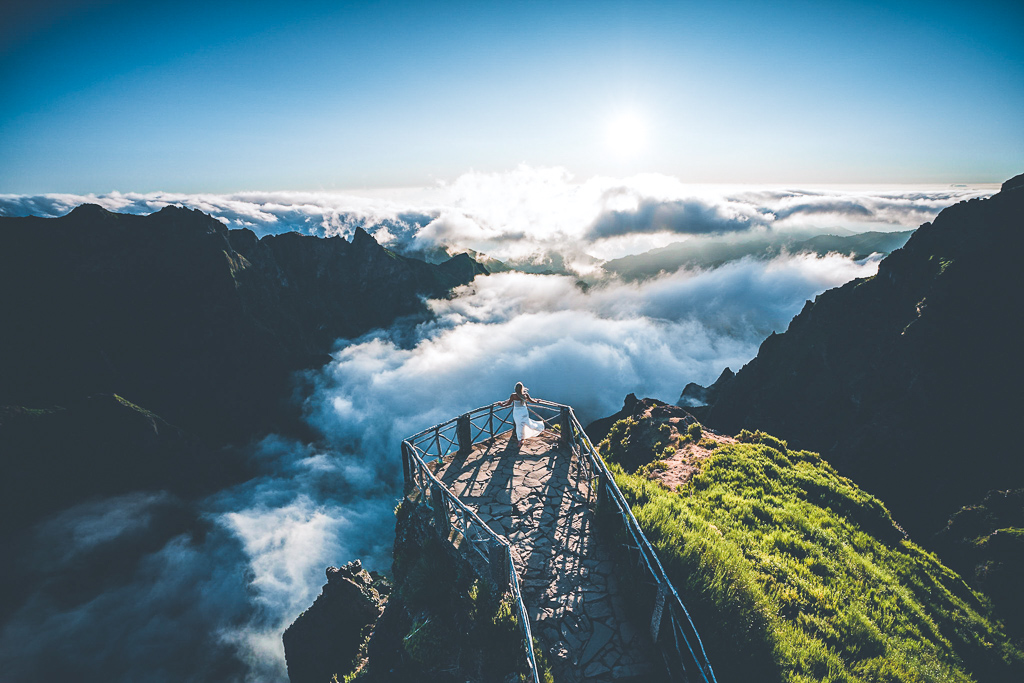
At 1,818 metres, Pico do Arieiro is Madeira's third-highest peak and one of the most accessible. A paved road leads all the way to the summit, where on clear days you can see the neighbouring island of Porto Santo and, on exceptional days, the Canary Islands. The summit often rises above a sea of clouds, creating a surreal landscape of rocky peaks floating in white. The sunrise from Pico do Arieiro is one of the most spectacular in Portugal — arrive before dawn and bring warm layers.
Levada do Caldeirão Verde: The Best Levada Walk
Madeira's levadas — ancient irrigation channels that thread through the mountains — are the island's most distinctive feature. The Levada do Caldeirão Verde in the Queimadas Forest Park near Santana is widely considered the most beautiful levada walk. The 13 km round trip passes through ancient laurel forest, through four tunnels (bring a torch), and ends at a dramatic waterfall in a green amphitheatre. The drive to the trailhead through the mountains above Santana is spectacular in itself.
Porto Moniz: Natural Lava Pools
On Madeira's northwest tip, Porto Moniz is famous for its natural swimming pools formed by ancient lava flows. The pools are connected to the Atlantic by channels that allow seawater to flow in and out, keeping them clean and refreshing. The drive from Funchal via the north coast road (EN101) is one of the island's great scenic routes, hugging the cliffs above the sea for much of its length. Allow at least 90 minutes for the drive each way and stop at the Miradouro do Véu da Noiva viewpoint for views of the island's tallest waterfall.
Santana: Traditional Thatched Houses
The village of Santana on the north coast is famous for its palheiros — traditional A-frame thatched houses painted in bright colours. The village itself is charming, but the real reward is the drive through the mountains to reach it. The road from Funchal via Poiso and Ribeiro Frio passes through the heart of the Laurisilva forest, a UNESCO World Heritage Site and one of the last remaining examples of the ancient laurel forest that once covered much of southern Europe.
Ponta de São Lourenço: The Wild Eastern Peninsula
The Ponta de São Lourenço is Madeira's easternmost point, a narrow rocky peninsula that juts into the Atlantic. The landscape here is completely different from the rest of the island — dry, windswept, and dramatic, with red and ochre cliffs dropping into turquoise water. A 6 km hiking trail (3 hours return) leads to the tip of the peninsula. The drive from Funchal via the VR1 expressway takes about 40 minutes.
Curral das Freiras: The Valley of the Nuns
Hidden in a deep volcanic crater in the centre of the island, Curral das Freiras (Valley of the Nuns) was so isolated that nuns from Funchal fled here during pirate raids in the 16th century. The viewpoint at Eira do Serrado offers a dizzying view down into the crater, with the village 700 metres below. The winding road down into the valley is an experience in itself, with hairpin bends and sheer drops on either side.
Planning your Madeira road trip? Find the best car rental deals at Funchal Airport and start exploring. Compare Prices on GooRentalCars →
Practical Tips for Driving in Madeira
Madeira's roads range from modern expressways to narrow mountain tracks. The VR1 and VR2 expressways are fast and efficient, connecting Funchal to most parts of the island. There are no tolls on Madeira's roads. The mountain roads require confidence and patience — steep gradients, hairpin bends, and narrow village streets are common. An automatic transmission is strongly recommended for first-time visitors. Fuel stations are plentiful in Funchal and the main towns but sparse in the mountains — fill up before heading into the interior. Parking in Funchal city centre can be challenging; use the underground car parks near the seafront.
Related Articles
- Rent a Car in Madeira: Complete Guide
- Car Hire at Madeira Airport: Everything You Need to Know
- Driving in Madeira: Tips and Road Rules
- Best Places to Visit in Madeira
Frequently Asked Questions
Is it worth renting a car in Madeira?
Absolutely. A rental car is the best way to explore Madeira's most spectacular sights, many of which are inaccessible by public transport. The levada trailheads, mountain viewpoints, and north coast villages all require a car.
Is driving in Madeira difficult?
The expressways are easy to drive, but the mountain roads can be challenging for nervous drivers. Steep gradients, hairpin bends, and narrow village streets require care and patience. An automatic transmission is recommended.
Are there tolls in Madeira?
No. There are no tolls on any of Madeira's roads, including the expressways and tunnels. This is a significant advantage over mainland Portugal.
What is the best time to visit Madeira by car?
Madeira is a year-round destination, but spring (March to May) is particularly beautiful when the flowers are in bloom. Summer is warm and dry on the south coast. Winter brings more rain but also dramatic scenery and fewer tourists.
How long does it take to drive around Madeira?
A full circuit of the island takes about 4-5 hours of driving without stops. Most visitors spread their exploration over 3-5 days to allow time for hikes, viewpoints, and village visits.
What car should I rent in Madeira?
A compact car or small SUV with automatic transmission is ideal for Madeira. Avoid large vehicles, which struggle on the narrow mountain roads. Fuel-efficient diesel or hybrid models are recommended for the longer drives.